Expired registration in Oregon happens when a vehicle’s official registration is no longer valid. Driving a vehicle with expired registration can trigger fines, legal citations, and enforcement actions by state or local authorities. Oregon law requires all vehicles to display current registration, and failure to comply may affect insurance coverage and lead to additional penalties. Regularly monitoring the registration expiration date ensures drivers remain compliant with DMV regulations and avoids unnecessary legal complications.
Vehicle registration in Oregon generally follows a two-year cycle for most passenger vehicles, while newly purchased vehicles may receive an initial four-year registration. Oregon DMV Plate Services oversees the issuance, renewal, replacement, and management of license plates and registration credentials for vehicles statewide. Oregon registration expiration occurs precisely at the end of the registration term, with no grace period. After this date, the vehicle owner must renew registration immediately to maintain legal operation. Ignoring expired registration can result in late registration penalties, traffic violations, and municipal parking fines. Understanding these rules helps drivers plan renewals efficiently, prevents enforcement issues, and guarantees uninterrupted vehicle use.
What Is Expired Registration in Oregon?
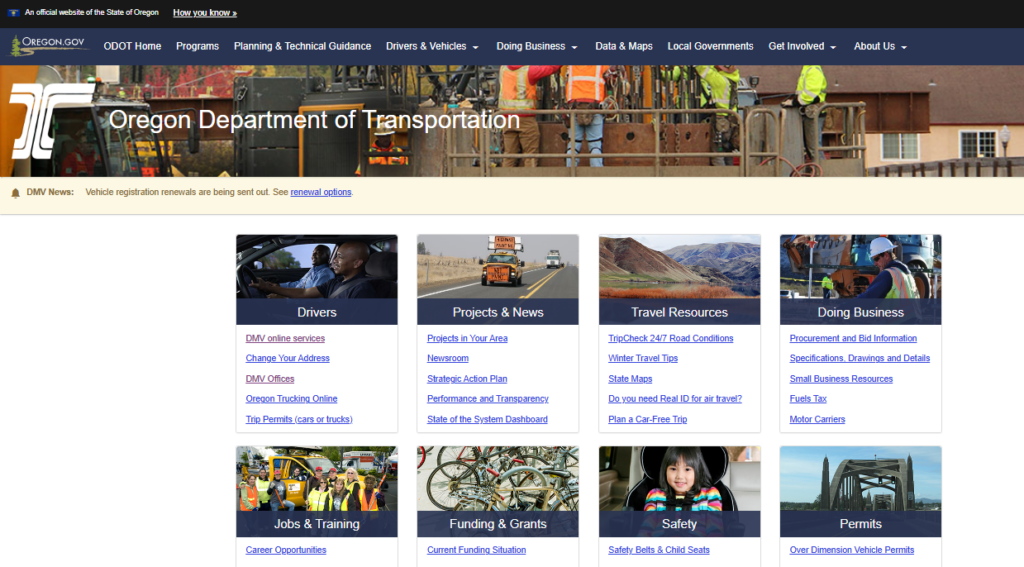
Expired registration in Oregon occurs when a vehicle’s official registration is no longer valid because the renewal deadline has passed. Driving a vehicle with expired registration is illegal, and owners must bring it current to comply with state law. Oregon law https://www.oregon.gov/odot/pages/index.aspx requires all vehicles to maintain valid registration through the Oregon Department of Transportation’s Driver and Motor Vehicle Services (DMV) division. This legal obligation ensures vehicles on public roads are properly documented and insured. Once a registration period ends, the vehicle is considered expired, and operating it without renewal violates DMV compliance rules.
Legal Requirements for Current Registration
Every vehicle owner in Oregon must register their vehicle for a set period, usually two years for standard passenger vehicles. Registration involves paying fees, providing proof of insurance, and, in some cases, passing emissions testing. The registration certificate https://www.oregon.gov/osp/pages/index.aspx and license plate validate that the vehicle meets state standards. Failing to renew on time results in an expired registration, which carries potential traffic violations and fines.
Key points about legal requirements:
- Registration must remain active throughout the period a vehicle is on public roads.
- Expired registration constitutes a Class D traffic violation under Oregon law.
- Vehicle owners must renew even if the car is rarely used; storage or parking does not exempt compliance.
What Constitutes Expiration?
Oregon does not offer a grace period after a registration expires. Once the expiration date arrives, the registration is invalid. Drivers cannot legally operate the vehicle until they complete the renewal process. This strict approach emphasizes compliance and ensures accurate DMV records.
Example timeline:
| Vehicle Type | Initial Registration | Expiration Date | Notes |
|---|---|---|---|
| Standard passenger vehicle | March 15, 2026 | March 15, 2028 | Renewal must occur by this date |
| New vehicle with Manufacturer’s Certificate of Origin | March 15, 2026 | March 15, 2030 | First registration lasts 4 years; subsequent renewals are biennial |
Even a one-day delay means the registration has expired. Drivers may still renew online or in person, but the vehicle is considered noncompliant until fees are paid and DMV records are updated.
Real-Life Context
Consider a driver whose registration expired on March 15, 2024. If they operate the vehicle on March 16 without renewal, they risk traffic fines and potential parking citations if parked in public areas. Keeping track of expiration dates and renewing promptly aligns with DMV compliance rules and avoids unnecessary penalties.
Takeaways:
- Expired registration applies immediately after the expiration date.
- DMV compliance rules require vehicles to be legally registered to operate.
- Online renewal is available for vehicles expired for less than one year, while long-expired registrations require in-person processing.
By following these rules, vehicle owners stay compliant with Oregon law and avoid fines, citations, or additional legal complications.
Oregon Vehicle Registration Terms & Expiration Rules
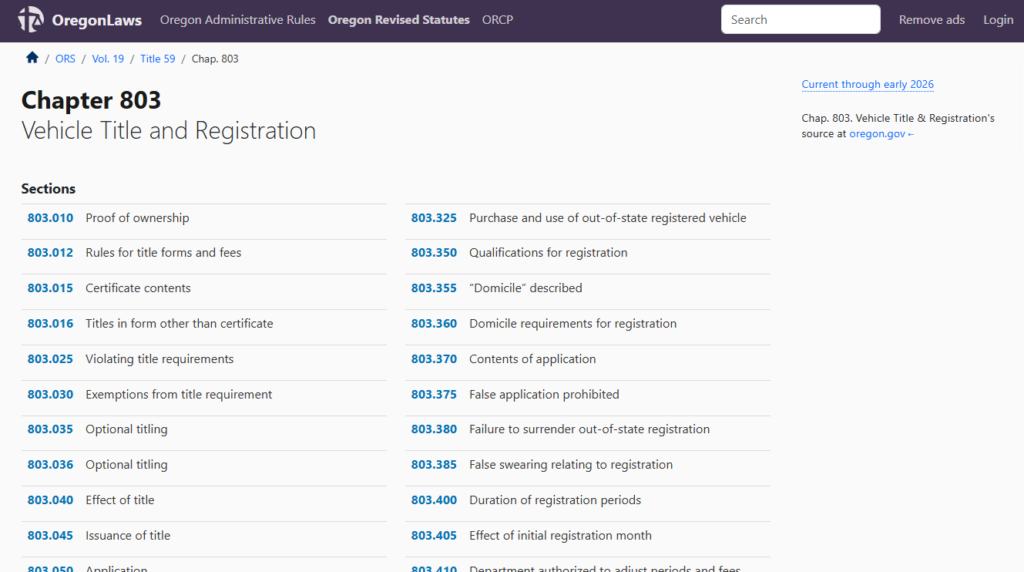
Vehicle registration in Oregon operates on clearly defined cycles, and every vehicle owner is legally required to keep their registration current. Oregon does not provide a grace period, so renewal must happen before the expiration date to remain compliant. These rules https://oregon.public.law/statutes/ors_chapter_803 help drivers avoid fines, penalties, and legal issues. Oregon registration expiration affects all passenger vehicles, specialty plates, and commercial vehicles, and knowing how cycles and renewal policies work ensures smooth compliance.
Biennial & Other Registration Cycles
Most passenger vehicles in Oregon follow a biennial registration system, meaning registration is valid for two years from the initial registration date. The expiration date is calculated exactly two years from the registration start date. For example, a vehicle registered on March 15, 2026, will expire on March 15, 2028. Renewing the registration before the expiration date continues this cycle seamlessly.
Exceptions include:
- New vehicles: Vehicles with a Manufacturer’s Certificate of Origin receive an initial four-year registration before switching to the standard two-year cycle.
- Commercial vehicles: May have different cycles depending on weight, usage, and type.
- Specialty or personalized plates: Follow the standard biennial schedule unless otherwise specified.
Renewal affects the expiration date directly. When a vehicle is renewed, the new registration period begins immediately after the current period ends. This prevents any lapse in legal coverage and ensures compliance with DMV rules.
Quick tips for drivers:
- Check your registration card for the exact expiration date.
- Use reminders from DMV2U or calendar alerts to avoid late renewal.
- Confirm vehicle classification; commercial and specialty vehicles may have additional requirements.
No Grace Period After Expiration
Oregon does not offer a grace period for expired registration. Once the expiration date passes, operating the vehicle on public roads becomes illegal. A common misconception is that there is a few-day buffer, but enforcement is immediate, and penalties apply. According to ORS 803.450, vehicle owners are expected to renew registration before the end of the term. Notices sent by the DMV do not extend the legal expiration date; they serve only as reminders. Driving with expired registration can trigger penalty fees, traffic citations, and even city-level parking fines.
Penalties & Legal Consequences of Driving with Expired Registration
Driving with an expired vehicle registration in Oregon can result in fines, citations, and other legal consequences. The severity of penalties depends on how long the registration has been expired and whether the vehicle is operated on public roads.
State Traffic Violation Penalties
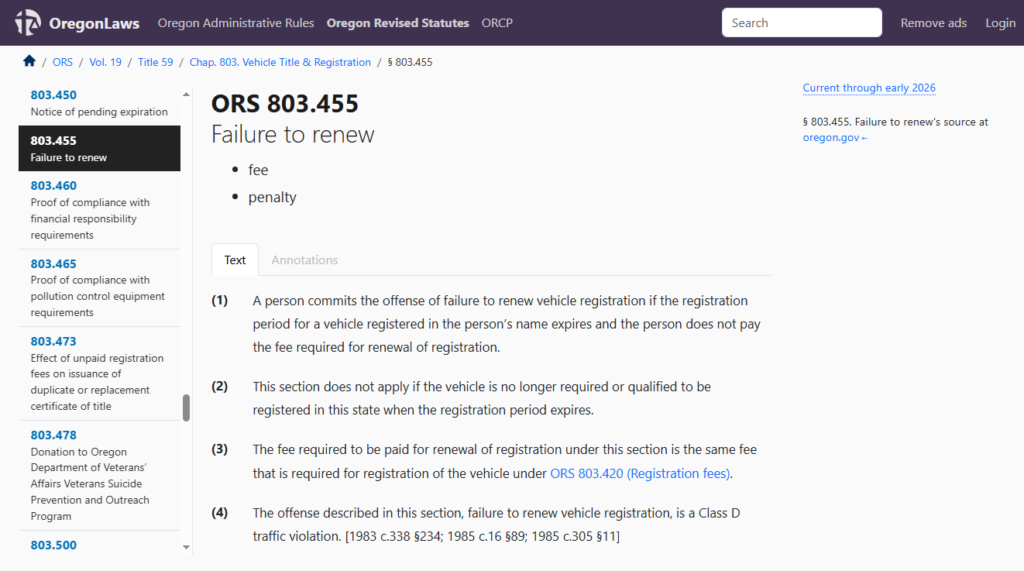
Operating a vehicle with expired registration in Oregon constitutes a Class D traffic violation. The base fine for this offense is typically $115, but courts may increase the penalty for vehicles with longer expiration periods or repeat violations. Oregon law (ORS 803.455) specifies that https://oregon.public.law/statutes/ors_803.455 anyone driving a vehicle after the registration period has ended is committing a legal offense. Courts can issue additional fees or penalties based on circumstances, including:
- Length of expiration: The longer the registration has lapsed, the higher the potential fine.
- Repeat offenses: Multiple violations can result in larger fines or a court summons.
- Traffic citations combined with other violations: If expired registration is found during other traffic stops, fines may accumulate.
Drivers are advised to renew their registration promptly to avoid https://oregon.public.law/statutes/ors_153.019 these penalty fees and remain compliant with Oregon traffic laws.
Administrative & DMV Penalties
Oregon DMV does not charge late fees for renewing expired registration https://www.oregon.gov/odot/dmv/pages/index.aspx if the lapse is less than one year. However, the renewal process may be affected if a registration has expired for more than 75 days. In such cases:
- Online renewal via DMV2U may be restricted, requiring in-person visits.
- Standard biennial registration fees apply, even for late renewals.
- Proof of insurance and current emissions testing may be required before the DMV can process renewal.
This ensures vehicle owners meet DMV compliance rules while updating their registration. Keeping registration current prevents administrative complications and ensures proof of registration is valid when driving.
Local Enforcement
City authorities in Oregon can issue parking citations for expired registration, separate from state traffic violations. For example, in Portland:
| Expired Days | Parking Fine |
|---|---|
| 0–90 days | $70 |
| 91+ days | $145 |
These fines apply even when the vehicle is parked and not in operation. Local enforcement works independently of state authorities, so a vehicle with expired registration may face parking enforcement expired registration penalties as well as state traffic fines.
Additional Enforcement Risks
In extreme cases, repeated violations or significantly https://www.portland.gov/transportation/parking/parking-violations# expired registration can lead to more serious consequences:
- Vehicle tow and impoundment: Some municipalities may tow vehicles with expired tags left on public property.
- Court appearances: Long-term expired registration can result in mandatory court hearings.
- Combined fines: Fines for traffic violations and parking citations can accumulate quickly, increasing financial liability.
Being proactive about renewing registration minimizes exposure to these risks and ensures compliance with both state and local DMV enforcement rules.
How to Renew an Expired Registration in Oregon
Renewing an expired vehicle registration in Oregon is a straightforward process. Vehicle owners can complete the renewal online, in person, or by mail, depending on how long the registration has expired. Cancel Vehicle Registration Online in Oregon is also an available option for those who no longer need their vehicle registered, offering a convenient way to formally end registration without visiting a DMV office. Keeping registration current is critical to avoid traffic fines, parking penalties, and compliance issues. Oregon DMV provides multiple renewal and cancellation options to accommodate different situations, whether the registration has lapsed for a few months or over a year.
Renewal Options
Oregon offers three main ways to renew an expired registration, each tailored to the length of time since expiration. Online renewal through DMV2U is available for registrations expired for less than one year. Users can log in with their VIN and renewal PIN to pay the standard registration fee and print a temporary receipt valid for 30 days. This method is fast and convenient, allowing vehicle operation while waiting for official documents. For registrations expired for over one year, renewal must be completed in person at a DMV field office. This ensures proper verification of documents and compliance with DMV rules. The in-person process may include proof of insurance, emissions testing confirmation, and identity verification.
Renewal by mail is another option in certain cases, typically when a renewal notice is received, and all required documents are included. Mail-in renewals must include the completed DMV forms, payment, and proof of insurance, and they are processed in the order received.
Key points for renewal options:
- Online (DMV2U): less than 1 year expired, temporary receipt valid for 30 days.
- In person at DMV: more than 1 year expired, full verification required.
- By mail: complete forms, include proof of insurance, and payment.
Steps Renewal Process
The renewal process is simple when following each step carefully. For online renewal, start by visiting the DMV2U website or contacting the DMV call center. Enter the Vehicle Identification Number (VIN) and the PIN from the renewal notice. The system calculates the standard registration fee, and payment can be made using a debit or credit card. After payment, the system generates a temporary registration receipt. This document should be kept in the vehicle at all times, as it is considered valid for 30 days while permanent registration materials are mailed.
For in-person renewal, the process includes:
- Bring the renewal notice or current registration.
- Provide proof of insurance and emissions testing, if applicable.
- Complete the payment of the registration fee.
- Receive your new registration certificate and tags immediately.
Mail-in renewal requires assembling all required documents, payment, and completed forms. Send them to the DMV address listed on the renewal notice and allow processing time before driving the vehicle.
Fees & Documents Required
Oregon does not charge additional late fees for renewing expired registration, but the full standard registration fee applies. For most passenger vehicles, this is a biennial fee, plus any applicable county charges.
Required documents for renewal include:
- Current or expired registration notice
- Proof of liability insurance
- Emissions test certificate (if applicable for your county or vehicle type)
- Payment for the registration fee
These items ensure compliance with DMV rules and prevent fines. Keeping insurance and emissions current can avoid further administrative issues or enforcement penalties.
Common Renewal Scenarios
Renewal after short lapse (<1 year):
- Eligible for online DMV2U renewal.
- A temporary receipt allows legal driving while waiting for documents.
- Standard registration fee applies; no additional late charges.
Renewal after long lapse (>1 year):
- Must renew in person at a DMV field office.
- Verification of insurance, emissions, and identity is required.
- Online renewal is not available.
Out-of-state transfers:
- Vehicles brought from another state require new Oregon registration.
- Must provide title, proof of insurance, and emissions compliance.
- The initial registration fee may include first-time vehicle fees in addition to standard biennial registration.
Following these steps ensures vehicle owners regain legal compliance quickly, avoid traffic penalties, and maintain DMV compliance rules.
Special Situations & Exceptions
Certain vehicle owners in Oregon may qualify for special rules when renewing expired registration. These exceptions can reduce penalties or allow alternative renewal methods.
Military Active Duty Extension Exceptions: ORS 803.417
Oregon law grants active duty military personnel extensions on vehicle registration renewals. Service members deployed away from the state can delay renewal without incurring penalties. This rule applies to members of the U.S. Armed Forces, including National Guard and Reserves, who are stationed outside Oregon.
- Registration periods may be extended for the duration of deployment.
- Renewal can occur upon return without late fees, provided documentation of service is presented.
- Vehicle owners must submit military orders or official deployment papers when renewing at a DMV office.
This exception ensures compliance with DMV rules while recognizing the unique circumstances of military service. It also allows families to avoid unnecessary fines while the service member is absent.
Out‑of‑State Vehicles Entering Oregon
Vehicles newly brought into Oregon from another state must register within 30 days of establishing residency. Owners moving from out of state may encounter expired registrations during this period.
Oregon DMV requires:
- Submission of the previous state’s registration documents.
- Proof of insurance that meets Oregon minimum coverage.
- Payment of applicable registration fees, including title transfer fees if needed.
If the previous registration has expired, the DMV permits renewal at the standard biennial rate without additional late fees, as long as the registration is not older than one year. This process ensures compliance with Oregon vehicle laws while providing flexibility for new residents.
Vehicles Not Driven
Owners who do not plan to operate a vehicle on public roads can apply for alternative registration options. These include:
- Trip permits – allow temporary use for specific travel purposes, such as moving the vehicle.
- Seasonal or stored registration – suspends registration for inactive vehicles while maintaining legal compliance.
- Reduces the cost of maintaining registration on vehicles not in regular use.
Using these options prevents unnecessary fines for expired registration and helps vehicle owners stay compliant with DMV compliance rules. Vehicle owners must provide proof of storage or intended temporary use to qualify.
Government Agencies & Contacts
For vehicle registration and compliance in Oregon, the Oregon Department of Transportation (ODOT), the Driver and Motor Vehicle Services (DMV) Division, and the Oregon State Police (OSP) are the primary authorities. These agencies oversee registration requirements, enforcement standards, and related administrative processes, offering official guidance for both expired and current registrations. When vehicle owners need to Renew Vehicle Registration, the Oregon DMV provides clear instructions, deadlines, and eligibility requirements to help prevent lapses in compliance. Oregon residents can rely on these agencies for accurate information regarding renewal options, penalties for expired registration, and documentation requirements. Maintaining updated registration and knowing where to renew helps drivers avoid fines, enforcement actions, and unnecessary delays.
Oregon Department of Transportation
ODOT oversees transportation systems and enforces regulations affecting vehicle registration across the state. It provides guidance on compliance rules and supports residents with vehicle-related inquiries.
Contact Information:
- Address: 355 Capitol Street NE, Salem, OR 97301
- Phone: 1-888-275-6368 (1-888-ASK-ODOT)
- Website: https://www.oregon.gov/odot/pages/index.aspx
Residents can call ODOT for general registration questions, procedural clarifications, and assistance with statewide transport regulations.
Driver and Motor Vehicle Services (DMV) Division
The DMV Division directly manages registration, license issuance, and renewal processes. They also provide online services, including the DMV2U portal, which allows vehicle owners to pay fees and update registration records efficiently.
Contact Information:
- Address: 1905 Lana Avenue NE, Salem, OR 97314
- Phone: 503-945-5000 (Salem Metro Area) | 503-299-9999 (Portland Metro Area)
- Website: https://www.oregon.gov/odot/dmv/pages/index.aspx
The DMV helps residents understand late registration rules, penalty fees, and renewal after expiration. Online tools make it easier for owners to maintain compliance without unnecessary trips to the office.
Oregon State Police – General Headquarters
The Oregon State Police enforce traffic laws, including penalties for operating a vehicle with expired registration. They also collaborate with municipal authorities on compliance enforcement.
Contact Information:
- Address: 3565 Trelstad Avenue SE, Salem, OR 97317
- Emergency: 911
- Non-Emergency: OSP (677 from mobile phones), 1-800-442-0776
- Website: https://www.oregon.gov/osp/pages/index.aspx
OSP can answer questions regarding the legal consequences of expired registration, traffic violations, and enforcement procedures. Residents are encouraged to contact OSP if they face citations or have concerns about compliance.
(FAQ) About Expired Vehicle Registration
Many vehicle owners in Oregon have questions about expired registration, penalties, and how to renew after the expiration date. This section answers the most common concerns and provides clear guidance on staying compliant with DMV rules and avoiding late registration penalties.
Is there a grace period for expired Oregon registration?
Oregon does not offer a grace period for vehicle registration. Once a registration expires, the vehicle cannot be legally driven on public roads until it is renewed. Vehicle owners who operate an expired vehicle risk penalty fees and a traffic violation under ORS 803.455. While the DMV itself does not charge additional late fees for renewals within one year, local jurisdictions may issue fines for vehicles parked with expired tags. Understanding DMV compliance rules helps drivers avoid these legal and financial consequences and ensures their vehicle remains properly registered.
Can I renew an expired registration online?
Yes, vehicles with registration expired for less than one year can be renewed online using DMV2U. The process requires the vehicle identification number (VIN) and personal details, and the standard registration fee must be paid. After completion, DMV2U provides a temporary receipt valid for 30 days while official registration documents are mailed. Registrations expired for more than one year require in-person renewal at a DMV office. Following these procedures carefully ensures compliance with Oregon law and avoids late registration penalties.
What happens if I never renew expired tags?
Failing to renew registration can lead to serious consequences. Driving with expired tags constitutes a Class D traffic violation, which can result in fines, court appearances, and potential vehicle impoundment. Additionally, many cities, including Portland, issue parking enforcement penalties for vehicles displaying expired registration even when not in use. Beyond fines, insurance coverage could be affected because most insurers require proof of valid registration. Prompt renewal after expiration maintains compliance, avoids unnecessary penalties, and protects insurance coverage.
Will insurance be impacted by expired registration?
Expired registration can complicate insurance matters. While insurance policies generally remain active, claims involving a vehicle with expired registration may face verification issues. Insurers often require proof of current registration for coverage confirmation, and repeated violations could flag compliance concerns in their records. Maintaining updated registration aligns with DMV compliance rules and ensures uninterrupted coverage, particularly when renewing after expiration or transferring insurance to a new provider. Keeping renewal receipts is recommended as proof in case of disputes.
Do I get a full 2 years after renewing an expired registration?
Yes, renewing an expired registration restores the standard registration period. Most passenger vehicles receive a two-year term starting from the renewal date, regardless of how long the registration has expired. Vehicles initially registered with a Manufacturer’s Certificate of Origin receive a four-year first term, but subsequent renewals follow the standard biennial cycle. Completing late registration properly through DMV2U or in person guarantees that the vehicle remains legal to operate and complies fully with Oregon registration laws.